
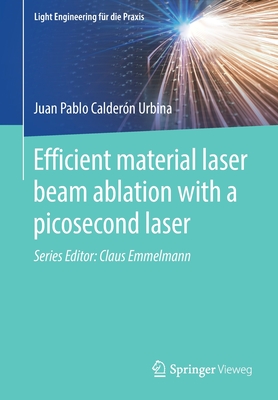
Efficient Material Laser Beam Ablation with a Picosecond Laser
| AUTHOR | Caldern Urbina, Juan Pablo |
| PUBLISHER | Springer Vieweg (07/23/2020) |
| PRODUCT TYPE | Paperback (Paperback) |
Description
Ultra-short pulse laser processing of ultra-hard materials requires an accurate and agile experimental and analytical investigation to determine an efficient choice of parameters and settings to optimize ablation. Therefore, this work presents a quality-oriented experimental approach and an analytical approach for the modeling and validation of multi-pulse picosecond laser beam ablation on cemented tungsten carbide. This work starts with a review of literature and state-of-the-art theories of four relevant areas for this research: picosecond lasers, laser beam ablation process, cemented tungsten carbide (WC) and quality-oriented tools. Subsequently, a concept for an efficient material laser beam ablation with a picosecond laser was introduced. Furthermore, two approaches for the investigation are presented from an experimental and analytical perspective, respectively. The first approach introduced a methodology for the identification of influential parameters. It executes a quality-oriented methodology based on the SWOT analysis, cause-and-effect diagram and the variable search methodology. The conclusion of the methodology gave the interaction of pulse repetition rate and scanner speed in the form of pulse overlap and track overlap PO/TO as the most influential parameter in the maximization of the ablation rate. The second most influential factors resulted laser beam power and burst-mode. The second approach, description of the model, executes a theoretical analysis of the picosecond laser beam ablation of cemented WC by the application of the Beer-Lambert law and multi-pulse ablation modeling. The unavailable material properties were obtained by experimental investigations, like in the cases of the incubation factor and the reflectivity factor. Threshold fluence for cemented WC was determined by the application of the heat transfer theory and input power intensity was adapted to a Gaussian beam profile. At the end of the approach, power density visualizations of a picosecond laser pulse under the five available pulse repetition rates were modeled and validated. The findings from the adaptation of the Beer-Lambert law acted as basis for development of the multi-pulse laser ablation model for both single-pulse mode and burst-mode, respectively. Based on the definition of the number of pulses N irradiating the same area, the corresponding threshold fluence for N, the input fluence and incubation factor, ablation depth was modeled and experimentally validated. Finally, results and conclusions of both approaches were discussed and a framework for an efficient laser beam ablation was presented. Recommendations for further actions on research and industry were introduced at the end of the work.
Show More
Product Format
Product Details
ISBN-13:
9783662618851
ISBN-10:
3662618850
Binding:
Paperback or Softback (Trade Paperback (Us))
Content Language:
English
More Product Details
Page Count:
210
Carton Quantity:
17
Product Dimensions:
6.69 x 0.50 x 9.61 inches
Weight:
0.85 pound(s)
Feature Codes:
Illustrated
Country of Origin:
NL
Subject Information
BISAC Categories
Technology & Engineering | Manufacturing
Technology & Engineering | Physics - Optics & Light
Descriptions, Reviews, Etc.
jacket back
The development of ultra-short pulse lasers has given laser beam ablation a wider application perspective by granting minimal thermal side-effects, industrial robustness and precision. A rising field of opportunity is the processing of ultra-hard materials. The intersection of reliable ultra-short pulse laser sources and the increasing trend of hardness represents an opportunity for laser beam ablation. This thesis describes the modeling and validation of multi-pulse picosecond laser beam ablation on cemented tungsten carbide (WC) to enable the identification of optimized parameter settings for an efficient ablation process. Thus, a quality-oriented experimental approach based on the variable search methodology was chosen. Within the multi-pulse laser beam ablation model, the Beer-Lambert law, heat transfer fundamentals, incubation and laser burst-mode are considered to accurately describe the process. Content
The author
Juan Pablo Calderón Urbina obtained his Bachelor's degree in Industrial Engineering at the Morelia Institute of Technology in Morelia, Mexico (Instituto Tecnológico de Morelia). He specialized in International Production Management at the Hamburg University of Technology (Technische Universität Hamburg) for his Master of Science's degree. Until 2013, he collaborated as a research assistant in several research and industrial projects with the Laser Zentrum Nord GmbH. In 2019, he concluded his scientific research and completed his doctorate at the HamburgUniversity of Technology, in the Institute of Laser and System Technologies (Institut für Laser- und Anlagensystemtechnik, iLAS).
- A concisejourney through the background and understanding of ultra-short pulse laser technologies
- Offers versatile application of quality-oriented tools in laser beam material processing
- Describes a single-pulse and multi-pulse model on cemented tungsten carbide capable to be adapted to other materials and laser systems
The author
Juan Pablo Calderón Urbina obtained his Bachelor's degree in Industrial Engineering at the Morelia Institute of Technology in Morelia, Mexico (Instituto Tecnológico de Morelia). He specialized in International Production Management at the Hamburg University of Technology (Technische Universität Hamburg) for his Master of Science's degree. Until 2013, he collaborated as a research assistant in several research and industrial projects with the Laser Zentrum Nord GmbH. In 2019, he concluded his scientific research and completed his doctorate at the HamburgUniversity of Technology, in the Institute of Laser and System Technologies (Institut für Laser- und Anlagensystemtechnik, iLAS).
Show More
publisher marketing
Ultra-short pulse laser processing of ultra-hard materials requires an accurate and agile experimental and analytical investigation to determine an efficient choice of parameters and settings to optimize ablation. Therefore, this work presents a quality-oriented experimental approach and an analytical approach for the modeling and validation of multi-pulse picosecond laser beam ablation on cemented tungsten carbide. This work starts with a review of literature and state-of-the-art theories of four relevant areas for this research: picosecond lasers, laser beam ablation process, cemented tungsten carbide (WC) and quality-oriented tools. Subsequently, a concept for an efficient material laser beam ablation with a picosecond laser was introduced. Furthermore, two approaches for the investigation are presented from an experimental and analytical perspective, respectively. The first approach introduced a methodology for the identification of influential parameters. It executes a quality-oriented methodology based on the SWOT analysis, cause-and-effect diagram and the variable search methodology. The conclusion of the methodology gave the interaction of pulse repetition rate and scanner speed in the form of pulse overlap and track overlap PO/TO as the most influential parameter in the maximization of the ablation rate. The second most influential factors resulted laser beam power and burst-mode. The second approach, description of the model, executes a theoretical analysis of the picosecond laser beam ablation of cemented WC by the application of the Beer-Lambert law and multi-pulse ablation modeling. The unavailable material properties were obtained by experimental investigations, like in the cases of the incubation factor and the reflectivity factor. Threshold fluence for cemented WC was determined by the application of the heat transfer theory and input power intensity was adapted to a Gaussian beam profile. At the end of the approach, power density visualizations of a picosecond laser pulse under the five available pulse repetition rates were modeled and validated. The findings from the adaptation of the Beer-Lambert law acted as basis for development of the multi-pulse laser ablation model for both single-pulse mode and burst-mode, respectively. Based on the definition of the number of pulses N irradiating the same area, the corresponding threshold fluence for N, the input fluence and incubation factor, ablation depth was modeled and experimentally validated. Finally, results and conclusions of both approaches were discussed and a framework for an efficient laser beam ablation was presented. Recommendations for further actions on research and industry were introduced at the end of the work.
Show More
List Price $139.99
Your Price
$138.59