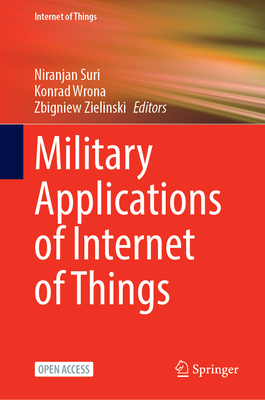
Military Applications of Internet of Things (Not yet published)
| PUBLISHER | Springer (01/18/2026) |
| PRODUCT TYPE | Hardcover (Hardcover) |
This open-access book examines the military applications of the Internet of Things in three main parts: (I) Motivation and Use Cases, (II) Challenges and Solutions, and (III) Experimental Results and Recommendations. The first part describes the motivation and selected Military IoT (MIoT) application areas. The second part provides an overview of the specific requirements that MIoT applications must meet, including the ability to process large volumes of diverse data, support for increased automation, robust device and network security, and resilience against electronic warfare measures. It examines existing architectural frameworks for IoT ecosystems and the challenges of integrating these frameworks into current military infrastructure, including communications, and proposes architectural patterns for integrating IoT into the military domain. Part II evaluates current IoT-related technologies for sensing, actuation, and communication relevant to the military domain. It also offers a comprehensive overview of various aspects of IT network security in military applications, including the concept of Data-Centric Security, which is viewed as a promising security model for future NATO operations. Other security considerations include securing data exchange between the IoT networks and federated C2 systems, leveraging publish-subscribe services, and incorporating trusted hardware components, such as TPM, into IoT devices to improve security. Part II also outlines a comprehensive approach to ensuring reliability and security across all layers and stages of the MIoT lifecycle and evaluates the suitability of selected fault-tolerance techniques in MIoT, including the need for fault-tolerance methods to be consistently applied across all layers. Part III summarizes five different categories of experiments conducted by the authors on a distributed NATO testbed at multiple physical locations to test and validate IoT technologies and their applications within the military domain.
This open-access book examines the military applications of the Internet of Things in three main parts: (I) Motivation and Use Cases, (II) Challenges and Solutions, and (III) Experimental Results and Recommendations. The first part describes the motivation and selected Military IoT (MIoT) application areas. The second part provides an overview of the specific requirements that MIoT applications must meet, including the ability to process large volumes of diverse data, support for increased automation, robust device and network security, and resilience against electronic warfare measures. It examines existing architectural frameworks for IoT ecosystems and the challenges of integrating these frameworks into current military infrastructure, including communications, and proposes architectural patterns for integrating IoT into the military domain. Part II evaluates current IoT-related technologies for sensing, actuation, and communication relevant to the military domain. It also offers a comprehensive overview of various aspects of IT network security in military applications, including the concept of Data-Centric Security, which is viewed as a promising security model for future NATO operations. Other security considerations include securing data exchange between the IoT networks and federated C2 systems, leveraging publish-subscribe services, and incorporating trusted hardware components, such as TPM, into IoT devices to improve security. Part II also outlines a comprehensive approach to ensuring reliability and security across all layers and stages of the MIoT lifecycle and evaluates the suitability of selected fault-tolerance techniques in MIoT, including the need for fault-tolerance methods to be consistently applied across all layers. Part III summarizes five different categories of experiments conducted by the authors on a distributed NATO testbed at multiple physical locations to test and validate IoT technologies and their applications within the military domain.
- Reviews how IoT capabilities could be integrated with military equipment;
- Offers examples of military IoT applications that use commercially available components and architectures;
- Examines the security, reliability, and dependability challenges faced in military IoT applications;
- Presents experimental results obtained in a multinational context.
This open-access book examines the military applications of the Internet of Things in three main parts: (I) Motivation and Use Cases, (II) Challenges and Solutions, and (III) Experimental Results and Recommendations. The first part describes the motivation and selected Military IoT (MIoT) application areas. The second part provides an overview of the specific requirements that MIoT applications must meet, including the ability to process large volumes of diverse data, support for increased automation, robust device and network security, and resilience against electronic warfare measures. It examines existing architectural frameworks for IoT ecosystems and the challenges of integrating these frameworks into current military infrastructure, including communications, and proposes architectural patterns for integrating IoT into the military domain. Part II evaluates current IoT-related technologies for sensing, actuation, and communication relevant to the military domain. It also offers a comprehensive overview of various aspects of IT network security in military applications, including the concept of Data-Centric Security, which is viewed as a promising security model for future NATO operations. Other security considerations include securing data exchange between the IoT networks and federated C2 systems, leveraging publish-subscribe services, and incorporating trusted hardware components, such as TPM, into IoT devices to improve security. Part II also outlines a comprehensive approach to ensuring reliability and security across all layers and stages of the MIoT lifecycle and evaluates the suitability of selected fault-tolerance techniques in MIoT, including the need for fault-tolerance methods to be consistently applied across all layers. Part III summarizes five different categories of experiments conducted by the authors on a distributed NATO testbed at multiple physical locations to test and validate IoT technologies and their applications within the military domain.