
What's Whole in Whole Language in the 21st Century?
| AUTHOR | Goodman, Ken |
| PUBLISHER | Garn Press (11/06/2014) |
| PRODUCT TYPE | Paperback (Paperback) |
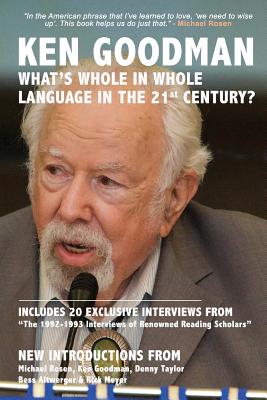
What's Whole in Whole Language in the 21st Century? includes a new introduction by Ken Goodman, commentary by Michael Rosen, and excerpts from a series of never published interviews conducted in 1992-1993 by Denny Taylor of renowned reading scholars who knew Ken and Yetta Goodman, and who spoke freely about their lives together as well as their research and teaching. The insights of these scholars, who include Frank Smith and Jeanne Chall, are profound. They shift the political discourse of reading research and teaching young children to read. Ousting the propaganda, they shed light on what really happened to progressive educators and whole language teachers at the end of the 20th century. The original version of Goodman's best-selling book sold two hundred and fifty thousand copies, became a worldwide phenomenon, and was translated into French, Spanish, Portuguese, Japanese and Chinese. It became the handbook for the revolution for equality and justice for all children that occurred in classrooms around the world. Teachers were inspired to put aside commercial materials that were based on very limited understandings of reading and writing, and instead placed children and their very natural curiosity about language and learning at the center of classroom activity. In the 1990's, the agenda for public education shifted away from developmentally appropriate teaching and learning and prominently featured the goals of curriculum standardization, test-based accountability, and a reward-and-punish policy toward school performance. Although conservative ideology and the thirst for profit were factors at play, the real motive was to ensure that U.S. corporations would remain competitive in the 21st century global market. They would achieve this by turning schools into "workforce development systems" that would produce future workers with very narrowly defined literacy proficiencies and a predilection for passivity and compliance. This is the experience of most public school children today, whose lives and academic development are so negatively impacted by the Common Core. There has never been a more critical time for teachers to read What's Whole in Whole Language in the 21st Century? It is as prescient today as it was when Goodman first wrote it.
What's Whole in Whole Language in the 21st Century? includes a new introduction by Ken Goodman, commentary by Michael Rosen, and excerpts from a series of never published interviews conducted in 1992-1993 by Denny Taylor of renowned reading scholars who knew Ken and Yetta Goodman, and who spoke freely about their lives together as well as their research and teaching. The insights of these scholars, who include Frank Smith and Jeanne Chall, are profound. They shift the political discourse of reading research and teaching young children to read. Ousting the propaganda, they shed light on what really happened to progressive educators and whole language teachers at the end of the 20th century. The original version of Goodman's best-selling book sold two hundred and fifty thousand copies, became a worldwide phenomenon, and was translated into French, Spanish, Portuguese, Japanese and Chinese. It became the handbook for the revolution for equality and justice for all children that occurred in classrooms around the world. Teachers were inspired to put aside commercial materials that were based on very limited understandings of reading and writing, and instead placed children and their very natural curiosity about language and learning at the center of classroom activity. In the 1990's, the agenda for public education shifted away from developmentally appropriate teaching and learning and prominently featured the goals of curriculum standardization, test-based accountability, and a reward-and-punish policy toward school performance. Although conservative ideology and the thirst for profit were factors at play, the real motive was to ensure that U.S. corporations would remain competitive in the 21st century global market. They would achieve this by turning schools into "workforce development systems" that would produce future workers with very narrowly defined literacy proficiencies and a predilection for passivity and compliance. This is the experience of most public school children today, whose lives and academic development are so negatively impacted by the Common Core. There has never been a more critical time for teachers to read What's Whole in Whole Language in the 21st Century? It is as prescient today as it was when Goodman first wrote it.